

Golf as the Backbone of Retirement (and Why I Started Planning at 50)
The financial piece, the social piece, the lifestyle piece. Here is how I am actually thinking about it.
RETIREMENT PLANNING · GOLF · LIFESTYLE
I did not plan my retirement around golf. Golf planned itself into my retirement. And somewhere around 50, staring at a season that felt shorter every year, I realized I had better start paying attention to both.
If you are reading this, you are probably somewhere in that window. Close enough to retirement that it is real, far enough away that you still have choices to make. Maybe you are a mid-level executive who has done reasonably well. You are not wealthy enough to stop thinking about money, but you are not starting from zero either. Golf is something you love, something you have always told yourself you would play more of one day.
One day is coming. Here is how I am thinking about it.
The Social Architecture Nobody Talks About
The thing retirement planners never put in their presentations is this: the office is where most of us get our social life. The water cooler conversations, the lunches, the hallway check-ins. They feel like background noise until the day they stop.
Golf solves this problem in a way that almost nothing else does. A four-hour round with the same group every Saturday is not just exercise. It is a standing appointment with people who show up, week after week. It is a rhythm. And rhythm, it turns out, is one of the great underrated ingredients in a good retirement.
I have watched what happens to people who retire without that structure in place. They are fine for six months, maybe a year. Then the days start to blur. Golf gives you something to train for, something to argue about, something to look forward to. That is worth more than any financial product I have ever seen marketed to my age group.

How to Stretch Your Golf Budget Without Giving Up the Good Stuff
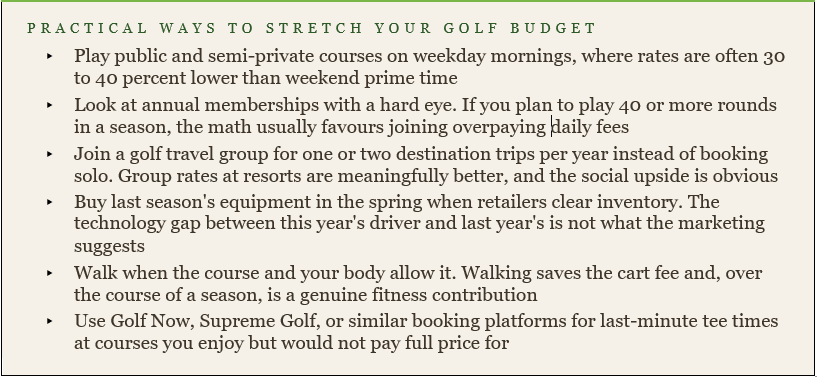
I am not going to pretend the math is painless. Green fees have gone up. Everything has gone up. But golf has one thing working in its favour for retirees that it does not offer working people: flexibility.
When you are not tied to a nine-to-five, you can tee off on a Tuesday morning at 8 a.m. when the course is half empty and the twilight-rate mentality is gone because the whole day is twilight. That is worth real money. Many courses price their midweek morning rounds significantly lower than weekend tee times. Over a full season, that gap adds up fast.
The bigger question is how golf fits into your overall retirement income picture. For most people in that mid-level executive bracket, retirement is not one income stream. It is a combination of a pension or 401(k)/RRSP drawdown, maybe some investment income, possibly some part-time consulting. Golf needs to have its own line item in that budget, treated with the same honesty as groceries or travel. When it lives in the vague category of entertainment, it tends to get either overspent or anxiously underspent.
Playing More Without Breaking Down
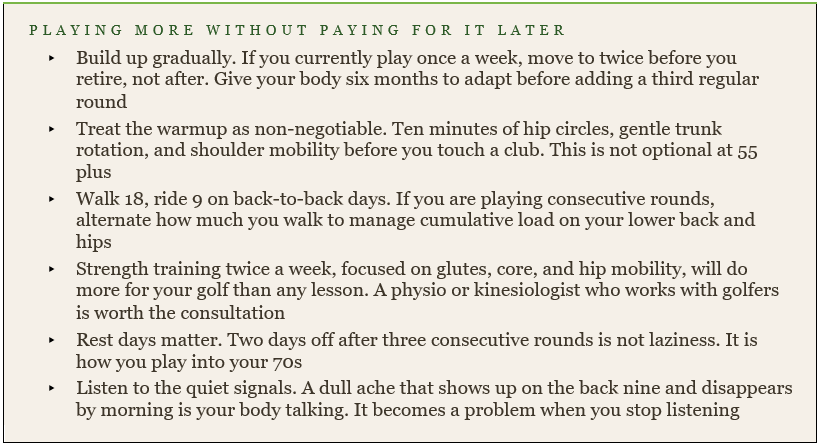
Here is the conversation nobody wants to have at 50, but everyone needs to. The body that plays golf at 60 is not the body that played it at 40. The hips are tighter. The lower back has opinions. The shoulder that was a bit sore for six months has now been a bit sore for three years.
I started paying attention to this after a fall trip where I played three consecutive rounds and could barely get out of bed on the fourth morning. Not injured, exactly. Just completely spent in a way that surprised me. It had been years since I played 18 on three consecutive days and it made me reconsider some of my life choices.
The research on this is pretty consistent. Golfers who go from occasional weekend play to daily retirement golf in a single step are the ones who end up with golfer's elbow, hip flexor strains, and the kind of lower back problems that chase them for years. The spine does not care that you have more free time. It needs progressive loading.
The goal is not to play as much golf as humanly possible in the first two years of retirement and then spend years three through ten recovering. The goal is to swing freely at 72 with a group of people you actually like.
What Golf Actually Costs You in Retirement (And What It Pays Back)
I have run the numbers a few times, and they always look roughly the same for someone playing two or three times a week through a season. All-in, including green fees, equipment maintenance, travel for one or two trips, and your share of the nineteenth hole, you are probably looking at somewhere between four and ten thousand dollars a year depending on where you live and how you play. That is a real number, and it deserves honest treatment in your retirement plan.
What the spreadsheet does not capture is what you get back. The mental health literature on retirement is sobering reading. Depression, cognitive decline, and loss of purpose are genuine risks for people who stop working without replacing the structure, the stimulation, and the social contact that work provides. Golf, done consistently and communally, addresses all three in ways that are hard to put a dollar figure on.
There is also the physical piece. Walking 18 holes three times a week is somewhere between 10,000 and 15,000 steps per outing, carrying or pulling your bag. That is a legitimate cardiovascular and musculoskeletal contribution. Compare the cost of that against what people spend on gym memberships they rarely use, and the math changes.

Starting the Conversation Now, Not Later
The reason I started thinking seriously about this at 50 is simple. By the time most people retire, their habits are already fixed. Their social circles are shrinking. Their body has already absorbed a decade of the wrong kind of physical neglect. You can recover from all of that, but it is easier and cheaper and more fun to build the foundation before you need it.
If you are 53 or 57 or 61 and you are reading this thinking it sounds roughly like your situation, here is what I would actually suggest doing. Not the financial planning, not the investment review. Just this: book a round with people you want to spend time with in retirement. Not your current work crowd necessarily. The people you want to be standing with at 68 on a sunny Tuesday morning at a course you can afford to love.
See if you can make that a regular thing before you retire. Because the social architecture and the physical habits and the course relationships you build before retirement are the ones that will carry you through it.
The back nine is longer than it looks. You want to walk into it with good footing.
Stay in the Fairway
If you found this useful, sign up for my newsletter to get the next issue delivered straight to your inbox. No spam, no fluff, just honest writing about golf, gear, and life on the back nine.
Dave is the founder of Back Nine Living, a golf and lifestyle site for players over 50. A lifelong golfer, he writes about golf, fitness, gear, travel, and the second half of life from his home base in Ontario, Canada.